Aircraft Disinfection at Zurich Airport — Protecting Passengers, Crew, and Asset Value
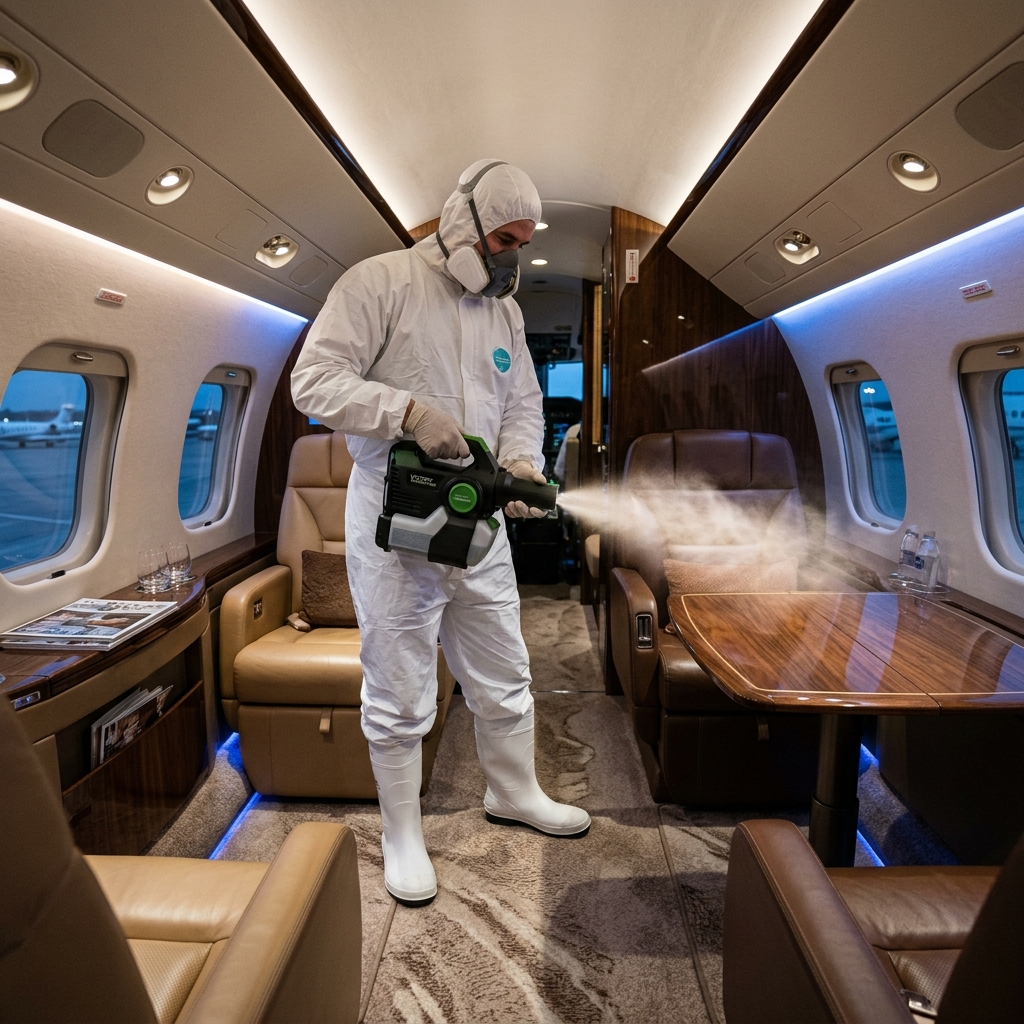
For private jet operators, the cabin environment is a duty-of-care issue as much as a commercial one. Passengers in a private jet cabin share a pressurised, recirculated air environment with a small group of people — often for extended periods on long-range flights. The hygiene standard of that cabin is the operator's responsibility.
We provide specialist aircraft cabin disinfection services at Zurich Airport (LSZH) using aviation-approved biocidal treatments that eliminate pathogens without damaging aircraft interior materials.
Why Aircraft Disinfection Is Different from Standard Cleaning
Standard interior cleaning removes visible contamination — dust, food residue, surface marks. Disinfection targets what cannot be seen: bacteria, viruses, fungi, and spores that survive on cabin surfaces for hours or days after a flight.
In a private jet cabin, the high-contact surfaces — armrests, tray tables, window shades, lavatory handles, galley surfaces, seatbelt buckles, and entertainment controls — are touched repeatedly by passengers and crew and are rarely disinfected to a clinical standard between trips.
Aviation-approved biocidal treatments used in aircraft cabin disinfection are proven to eliminate 99.9% of bacteria, viruses, spores, and fungi — including MRSA, Norovirus, and other high-risk pathogens.
Our Disinfection Process at Zurich
Our aircraft disinfection service at LSZH follows a structured, documented process:
Pre-disinfection clean
All visible contamination is removed before disinfection begins. Applying a biocidal agent over organic matter reduces its effectiveness. A pre-clean ensures the disinfectant makes full contact with the surface.
Surface disinfection — high-contact areas
All high-contact surfaces are treated manually with an aviation-approved disinfectant solution. This includes all passenger contact points, galley surfaces, lavatory fittings, and cockpit controls.
Fogging treatment
An airborne biocidal fogging treatment is applied throughout the cabin and cargo areas. The fog reaches surfaces and cavities that manual application cannot access — seat track channels, overhead bin interiors, HVAC distribution points, and lavatory extraction areas. Treatment must be completed with no crew or passengers on board.
Dwell time and ventilation
The biocidal agent is allowed to dwell for the manufacturer-specified contact time before the cabin is ventilated. This ensures full pathogen elimination across all treated surfaces.
Documentation
A service record is provided confirming the products used, coverage areas, and completion time — suitable for inclusion in the aircraft records or operator safety management system.
When Is Aircraft Disinfection Recommended?
- After transporting a passenger with a known or suspected illness
- Following a charter rotation through high-risk health regions
- As part of a scheduled quarterly maintenance programme
- Prior to a long-term owner handover or management change
- After extended ground storage before return to service
- Following catering or lavatory system issues during flight
Charter Operators — Duty of Care and Disinfection
For charter operators at Zurich, cabin disinfection is increasingly a client expectation rather than an optional add-on. High-net-worth passengers selecting private charter specifically to avoid the hygiene environment of commercial aviation will ask about cabin cleaning standards. Operators with a documented disinfection programme and verifiable service records are better positioned commercially than those without.
We can provide scheduled disinfection programmes aligned to charter rotation patterns, with documentation suitable for your safety management system and client communication.
Frequently Asked Questions
Is the fogging treatment safe for aircraft interior materials?
Yes. The biocidal agents used in our fogging treatment are specifically approved for use on aircraft interior materials — including leather, carpet, painted surfaces, and avionics — and leave no residue that could damage finishes or create electrical issues.
How long does the disinfection treatment take?
A full cabin disinfection including fogging typically takes 2–4 hours including pre-clean, treatment, dwell time, and ventilation. Aircraft should not be occupied during this period.
Can you provide documentation for our SMS or AOC records?
Yes. A full service record is provided after each disinfection treatment, including the products used and their approval references. This documentation is suitable for safety management systems and air operator certificate compliance files.
How often should a private jet be disinfected?
For actively chartered aircraft, we recommend a full disinfection every 4–6 weeks. For owner-operated aircraft, quarterly disinfection as part of a scheduled cleaning programme is typically sufficient.